

Effective Agile project delivery during COVID-19 in South Africa
By Berislav Savicevic, Principal Consultant at BSG
The global Coronavirus pandemic has impacted a number of areas of business, most notably it forced businesses into a remote delivery model many were not ready for. With many organisations having recently made, or in the process of making the change to an Agile delivery model, remote delivery was far from their minds.
Collaboration enabled by co-location is a cornerstone of the Agile delivery model. So, how do business leaders and Product Owners ensure their Agile teams continue to deliver value while working from home?
There’s no one answer, no magic silver bullet to ensure success, but by supporting five key principles true Agile remote delivery is indeed possible.
1. Focused and intentional communication is key
One of the reasons co-location is so central to Agile delivery is because it enables clear and uncomplicated communication. When we were co-located, if a team member needed clarity or further direction, they could simply walk over to their colleague’s desk and ask. But, when teams are distributed, this becomes more onerous. Many people feel more apprehension over phone or video calls than they would about popping up at a colleague’s desk or chatting to them at the coffee machine.
Transparency and empathy are key to successful remote communication and collaboration
This ultimately results in a lot more meetings for distributed teams, decreasing the amount of time available for core tasks – which we’ll cover in more detail a little later. To ensure meetings are effective, and the volume of them doesn’t become overwhelming, distributed teams need clear, focused and intentional communication to be successful. To overcome this, BSG’s Product Owners are checking their teams have received the message as intended by asking for playback from team members.
Nuances of communication are often lost when non-verbal communication is not possible. To ensure continued quality delivery to our clients, at BSG, we have used videoconferencing tools, such as Microsoft Teams, help to ensure non-verbal cues aren’t missed by our teams.
2. Don’t lose team culture
Culture develops organically when teams occupy the same space. This is another reason co-location is central to Agile, but it doesn’t mean you have to forgo culture where teams are distributed. In fact, fostering the right culture is even more important with distributed teams. Culture is a critical component for success and all too often, it’s diluted – or lost completely – when teams aren’t co-located.
To overcome this, at BSG, our Product Owners and Team Leads must ensure they are empathetic to one another’s realities. More than ever before, EQ is a critical component of successful leadership. Teams are grappling with challenges they’ve never faced before – balancing delivery with 24/7 family requirements, creating a work/life balance in this new normal, connectivity challenges and feelings of isolation to name a few.
Leaders, and team members alike, must be empathetic to the realities others are facing.
Leaders must ensure they are open and transparent. Open, transparent communication has never been more important. The volume of uncertainty is causing enormous additional emotional strain on team members.
To combat this, BSG’s leaders have ensured they are open with our people. This has helped to create trust and affinity across the organisation and within individual teams, something that is critical for success – whether the teams are distributed or not. Being transparent about the needs of the business and our clients, has enabled an outcomes-focused understanding that has helped keep our teams on-track, while giving them the space to work without micromanagement.
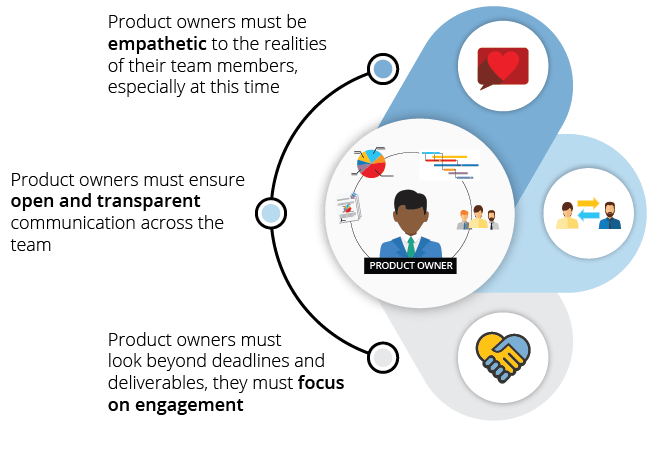
Furthermore, leaders must focus on engagement. Product Owners and Team Leads need to think beyond deliverables and deadlines, especially in the current climate. Ask team members how they’re coping – mentally and physically – how they’re adjusting and managing the additional requirements on their time.
At BSG, we are tracking this data on a holistic ‘mood dashboard’ that uses individual ratings to provide an overall view of the mental health of the business. This data is gathered through informal check-ins with team members, rather than during group sessions. This ensures team members who might feel uncomfortable discussing their personal challenges with the whole team, have the comfort they need to be open. Beyond this, we have found there is a need to be flexible on timelines and prepare yourself for an initial dip in productivity as your team comes to grips with remote delivery.
3. Ensure teams spend time on core tasks
To overcome not being co-located, we have seen a significant up-tick in meetings, as teams adjust to distributed delivery. It’s critical to keep an eye on this to ensure meetings don’t become overwhelming and all-consuming. We found some of our team members were spending five, six – sometimes seven – hours a day in meetings. With this reality, expecting them to stay on top of their delivery requirements was unrealistic, especially given the additional challenges many are facing with family requirements.
Be prepared for an initial dip in productivity as teams adjust to remote delivery
At BSG, our project delivery teams are using tools, such as Microsoft MyAnalytics, to enable team members to effectively track and manage collaboration time (i.e. time spent in meetings) versus focus time (i.e. time spent working on delivery), and understand and optimise their work patterns. This data is then also used to ensure meetings times are optimal for team members.
4. Iterate, iterate, iterate
Knowing there is likely to be a dip in productivity as teams adjust, we considered our sprint backlogs and how our incremental delivery could be further incremented. We looked at delivering smaller chunks of work and then focused on delivering continuous, iterative improvements.
At times like these, it’s easy to lose focus, become despondent or disinterested and disengage from the pursuit of the intended outcomes. Showing progress and claiming – and celebrating – small victories is one way our teams are maintaining morale. By focusing on delivering smaller chunks of value, and structuring the delivery so that items can be completed in a single day, our teams have a sense of achievement which keeps them motivated and focused on the end-goal.
Focus on delivering complete pieces of work each day to keep teams motivated
The continuous improvement model can just as easily be applied to the team structure. We have adjusted the team structures as needed to ensure effective collaboration and delivery. For example, at BSG, we have found some items are better delivered by smaller teams. It’s a lot easier to facilitate collaboration between three to four distributed people than it is with 7-9 team members. Through these ‘special forces teams’ we are able to ensure continuous, incremental delivery through effective collaboration.
5. Leverage the tools available
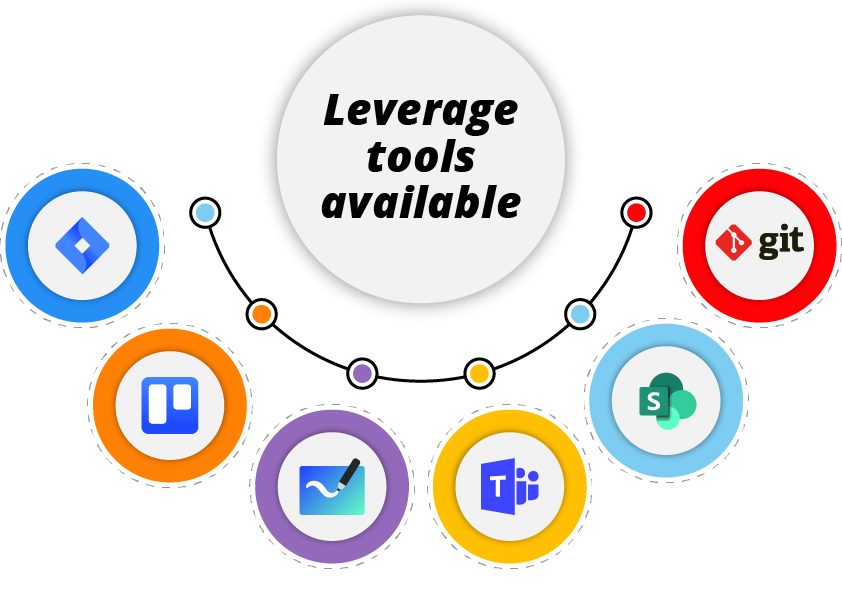
If nothing else positive emerges from this pandemic, we have seen a significant and rapid up-tick in digitisation of business processes. Just as videoconferencing tools, like Microsoft Teams, offer a virtual alternative to in-person communication, there have been significant advances in tools to further facilitate remote collaboration. At BSG, we are using:
- tools like Jira for adding user stories, tracking issues and bugs, and overall management of the project
- tools like Trello for tracking sprint backlogs and achieving greater visibility of work
- virtual whiteboards to facilitate effective collaboration within a distributed, cross-functional team
- tools like Microsoft Teams for videoconferencing and instant messages, creating a one-stop collaboration space for the team
- platforms like Sharepoint for collaborative, online file storage
- platforms like GitHub for code collaboration
We know that siloed teams don’t deliver business benefits the way that cross-functional teams do, this has been proven countless times. We also know the performance of siloed teams is even poorer when they’re distributed because the friction of hand-off is compounded by distance. This makes the Agile delivery model even more compelling.
At BSG, we are leaning toward Agile and keeping in mind that everyone is distributed during this time. By adapting and establishing what combination of tools and approaches works best for your teams, you will position yourself for distributed Agile delivery success.
We know that siloed teams don’t deliver business benefits the way that cross-functional teams do, this has been proven countless times. We also know the performance of siloed teams is even poorer when they’re distributed because the friction of hand-off is compounded by distance. This makes the Agile delivery model even more compelling. At BSG, we are leaning toward Agile and keeping in mind that everyone is distributed during this time.
By adapting and establishing what combination of tools and approaches works best for your teams, you will position yourself for distributed Agile delivery success.
Get in Touch
Let us help you. If you are looking to implement Agile project management practices in your business or, if you already have and would like help maintaining delivery with distributed teams, let us help you. BSG is fully operational with local insight and experience, and we can work with you to design the best solutions for your needs.