

Why Oil and Gas organisations should be making fact-based decisions
South African Oil & Gas (O&G) organisations have an opportunity to make fact-based decisions by leveraging big data and analytical techniques available to effectively respond to a low oil price environment. With multiple data sources available, internally and externally through digital sensors, meters, DCS, SCADA, Historian, transaction and automation systems, organisations need not miss this opportunity.
According to industry Analysts (Gartner, IDC, Forrester), Global leaders that source, consolidate, analyse and make fact-based decisions based on this data outperform their peers in this rapidly changing global market. Fact-based decisions help Executives and Managers to increase throughput, reduce down-time, improve safety records and enhance the customer experience.
We, at BSG, believe that South African O&G companies that find the story in the data will be the winners in the long run.
What are O&G Companies doing to address these challenges
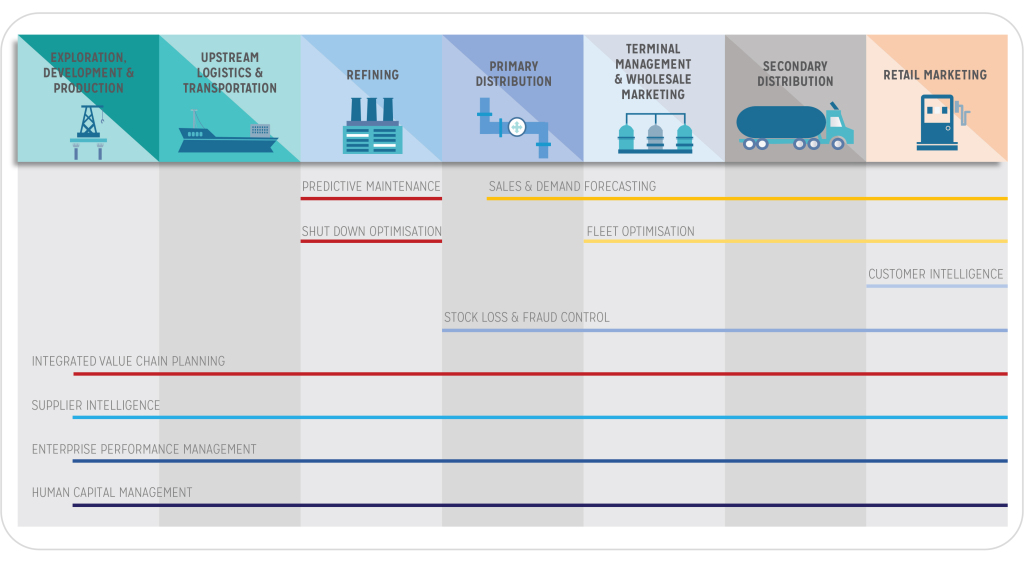
Many leading international O&G companies are already leveraging data, enabling them to make informed, fact-based business decisions and respond quickly to changing market dynamics. There are several key practices that we at BSG believe are critical to enable our clients to differentiate themselves in the local market:
 Predictive Maintenance
Predicting critical plant/equipment/machine (e.g. compressor, gas turbine) failure to a high degree of probability, thereby enabling technicians to proactively prevent unscheduled downtime.
Shut-down optimisation
Using integrated planning by leveraging data and analytical processes to produce a fact-based master plan to optimise the allocation of people, resources, consumables and equipment to reduce refinery shut down.
 Distribution
Analysing internal and external data to optimise route to customer, vehicle and driver scheduling and inventory allocations, thereby increasing vehicle utilisation.
 Stock loss/Fraud Detection (Downstream)
End-to-end supply chain data collection, storage and analysis to enable early warning of anomalies and outliers, thereby enabling loss reduction and prediction of suspicious behaviours in the future.
 Customer Intelligence (Retail Outlets/Service Stations)
Applying predictive analytics routines, such as segmentation and profiling, to gather customer and transactional insights, thereby improving asset and operational efficiencies. This can result in automation and optimisation of campaigns as a result, potentially leading to new client acquisitions, and retention and possibly growth of wallet share of existing clients in both retail and commercial segments.
Sales and demand forecasting (Retail & Distribution)
Accurately forecasting sales and demand using advanced statistical techniques to interpret internal and external data.
Integrated planning

Optimised planning using an integrated approach to produce a master plan on a single platform. Thereby resulting in improved allocation of inventories, materials, people and consumables in support of a continuous production process, increased through-put and reduced down-time.
Supplier intelligence
Analysing suppliers’ spending habits to predict future spend using a data-driven approach, thereby enabling rationalisation and optimisation of terms, buying patterns and behaviours.
Enterprise Performance Management
The ability to consolidate real-time data across customer, operations, risk and human capital from multiple sources into a single view enables better performance management using KPIs and dashboard visualisation approaches. Dashboarding also takes into account the in User Experience (UX) principles for deployment and use of intelligence across the enterprise.
Human Capital Management
Consolidating internal and external data to build a single view of employees, enabling prediction of future behaviour based on past behaviour, thereby empowering management to attract and retain top talent.
How can BSG help?
At BSG, customer-centric, fact-based decision making is in our DNA, and that, we believe, makes the difference. As a niche consulting and technology company with almost two decades experience and a proven performance history across numerous industries, we are passionate about being a proactive force for positive change, making a difference in everything we do. We are committed to delivering visible business benefit as a result of the work we deliver to our clients through our people.
In support of a fact-based approach, we believe that truly understanding the data at your disposal is fundamental to the success of any business improvement programme, whether improving operational efficiencies, managing risk and performance or understanding your customers. This belief underpins our commitment to building Customer Experience Design (CXD) and Business Analytics capabilities. In order to ensure the successful growth and development of these capabilities we have invested in executive level resources with over fifty years combined experience in these disciplines. These resources are committed to building the roles and competencies required to deliver these capabilities to the market.
The understanding of these two critical capabilities, coupled with integrated, agile delivery experience over silo-based delivery, affords BSG a unique position in the market.
Establishing a fact-based, customer-centric culture.
We are local and relevant
BSG, founded in Cape Town in 1997, identified a gap in the market for services to create synchronicity between business and IT functions. Initially specialising in Business Analysis, today BSG offers services designed to shape fact-based, customer-centric change in business operations, employing the latest technologies, combined with cutting edge methodologies, including Agile Development, Scrum and Running Lean practices.
BSG is recognised as a Level 2 B-BEE contributor. BSG Management and Employees hold the 60% majority share, with Hosken Consolidated Investments Limited (“HCI”) owning the remaining 40%. HCI is, in turn, majority owned by the Black-women owned (BWO) South African Clothing and Textile Workers Union (SACTWU).
To download a printable version of this story, click here.